
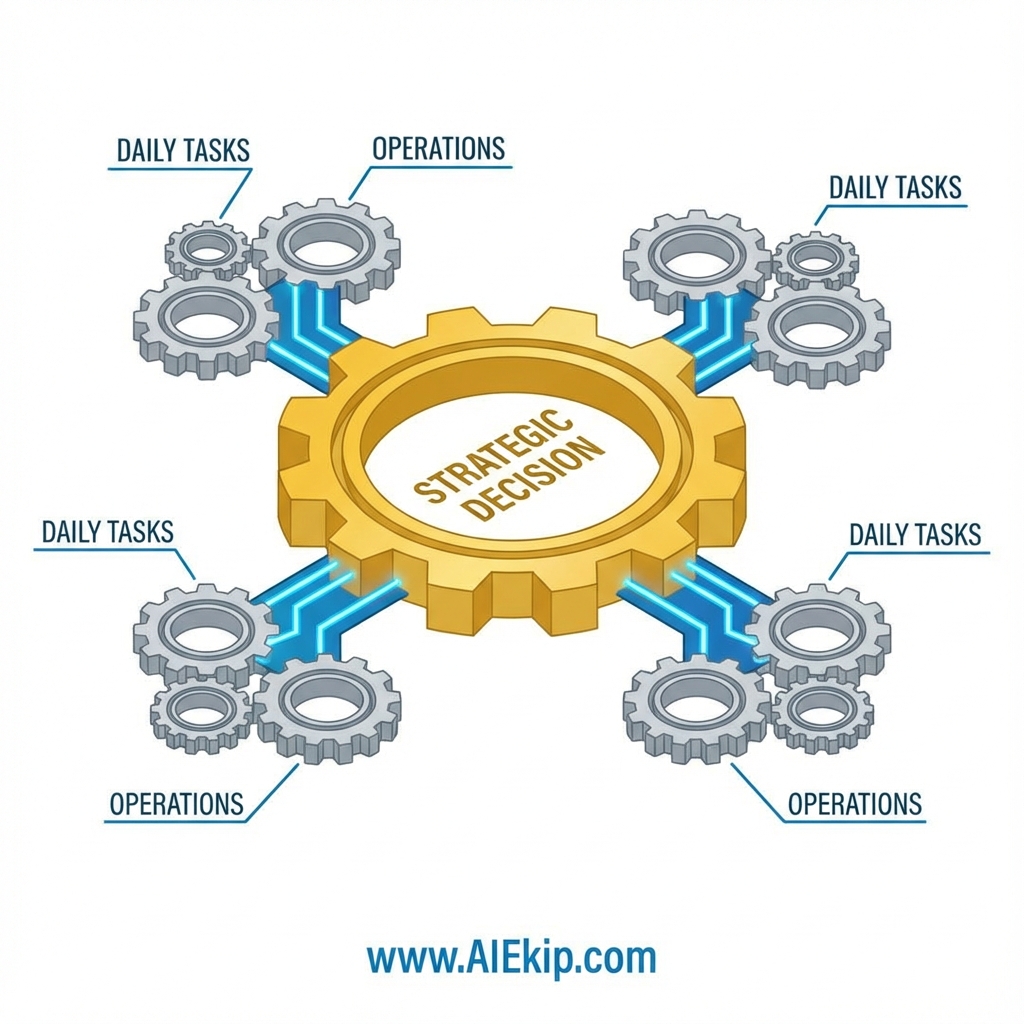
The Science of Strategic Leverage: Why 5% of Decisions Drive 80% of Success
In the high-stakes environment of modern business, leaders often succumb to the "activity trap"—the belief that being busy is synonymous with being productive. However, the reality of high-performance leadership is governed by a strict Pareto principle: not all decisions are created equal. In fact, roughly 5 to 10 percent of your decisions will generate 80 percent of your long-term consequences. This concept is the foundation of strategic thinking.
At AI Ekip, we specialize in helping organizations identify these high-leverage points. By automating the routine and optimizing the "noisy" 90 percent of operations, we empower CEOs and founders to focus their mental energy on the few choices that truly define their company's trajectory.
The Trap of Convenience
One of the most profound insights in decision science is that bad decisions rarely look like mistakes when they are made. Instead, they look like convenience. They are fast, they appear logical on the surface, and they are rarely questioned because they follow the path of least resistance. Strategic thinking begins the moment you pause. It requires a conscious desire to look past the "easy" answer to find the leverage point that actually moves the needle.
A Working Model for Strategic Thinking
To navigate complex, chaotic situations and choose a direction rather than just a next step, leaders need a repeatable framework. This 8-pillar model serves as a compass for those looking to master the art of strategy:
- Vision: Shift your perspective from quarters to years. While daily operations are important, strategy requires a long-term horizon.
- Analysis: Focus on identifying non-obvious consequences. This includes preparing for the unexpected secondary effects of success, not just failure.
- Problem Solving: Address the root causes of friction rather than just treating the symptoms. AI-driven data analysis is particularly effective here.
- Focus: Strategy is as much about what you stop doing as what you start. Find the leverage rather than simply adding more tasks to the backlog.
- Synthesis: The ability to connect disparate dots and turn raw insights into a cohesive action plan. This is where AI Ekip's dynamic knowledge bases provide a competitive edge.
- Storytelling: Data alone rarely motivates a team. Strategy requires communicating meaning and purpose to align the entire organization.
- Decisiveness: In an era of "big data," many wait for 100% clarity. Strategic leaders accept that 100% clarity is an illusion and act with calculated confidence.
- Adaptability: A great strategy is resilient. It allows for quick course corrections without shattering the underlying system or core mission.
How AI Facilitates Better Decisions
The primary barrier to strategic thinking is cognitive load. When a leader is buried under administrative tasks and operational bottlenecks, they lose the capacity for synthesis and vision. This is where AI workers and custom workflows become strategic assets. By deploying intelligent agents to handle customer support, sales qualification, or data indexing, you clear the mental runway required for high-level decision-making.
At AI Ekip, we don't just build tools; we build the infrastructure that allows you to stop being a "doer" and start being a "director." Our custom AI assistants and automation workflows are designed to handle the "convenient" tasks, freeing you to focus on the 5% that matters.
Conclusion: Strategy is a Skill, Not a Title
Being a strategist isn't about your position on the organizational chart; it is a skill that can be developed. It is what separates those who are merely busy from those who set the direction. By adopting a framework that prioritizes leverage and root-cause analysis, you ensure that your 5-10% of critical decisions are the right ones.